

Product Team Collaboration: One Platform for PM + Design + Growth
Product team collaboration breaks down when PM, design, engineering and growth work from different tools and different versions of the truth. Here's a better model.

Product team collaboration: one platform for PM + design + growth
Product team collaboration is broken in most companies, and almost nobody admits why.
The product manager has the roadmap in one tool. The designer has the figures in another. The engineering team works from a third. The growth team pulls dashboards from a fourth. Customer success watches the customer disappear from a fifth.
Then someone calls a meeting to "align," and the meeting becomes a slow re-negotiation of which version of reality everyone is looking at. By the time the team agrees on the truth, the truth has changed.
This is the real cost of fragmented tooling, and it's getting worse, not better. Atlassian's State of Teams 2024 found that teams now use ten or more tools just to manage daily workflows. Microsoft's Work Trend Index found that nearly half of employees, and more than half of leaders, say their work feels chaotic and fragmented.
This guide walks through what good product team collaboration actually looks like, why most teams get it wrong, and how a single visual source of truth changes the way PM, design, and growth work together.
Why product team collaboration breaks
Three patterns show up over and over in product organisations that are struggling to ship. None of them are about the people. All of them are about the system.
Different tools mean different versions of the truth
The PM is reading the roadmap in Linear. The designer is iterating in Figma. The growth lead is in Mixpanel. The engineer is in GitHub. The customer success manager is in Hubspot. None of them are looking at the same thing.
In a meeting, this turns into a long warm-up where each person updates the others on what their tool says. Half the meeting is sync. By the time the actual decision happens, the energy is gone.
The deeper problem is that even after the meeting, nobody's tools update. The decisions made in the room don't propagate. Two weeks later, the same conversation happens again, because the only place the alignment lived was in the heads of the people in the room.
Handoffs lose context
A designer hands a Figma file to engineering. The Figma file shows the screen. It doesn't show what the user did before, what they tried to do next, or which other screens this design depends on.
Engineering builds what they see. Customer success then reports that users are getting stuck. Nobody knows whether the design was wrong, the implementation was wrong, or the assumption underneath the design was wrong. The handoff stripped out the context that would have answered the question.
A handoff that loses context is the most expensive kind of friction in a product organisation. It compounds every time it happens.
Cross-functional teams aren't actually cross-functional
In a lot of companies, "cross-functional team" means "same standup, different priorities". The PM cares about roadmap velocity. The designer cares about craft. The engineer cares about technical debt. The growth lead cares about conversion. They sit in the same meeting. They're not solving the same problem.
A team that's nominally cross-functional but actually divided by tool, by metric, and by ownership will produce a product that feels divided, because the work was. Reforge has written about this in their long-running coverage of PM and product designer collaboration, where the authors point out that the difference between teams that ship great products and teams that don't often comes down to whether the people share an actual working medium, not just a shared meeting.
What a single visual source of truth looks like
A single source of truth is one of those phrases that gets thrown around so much it's lost meaning. Here's what it actually means in product team collaboration.
A single visual source of truth is a place where the team can see, in one view:
- The current state of the product, in real screens with real data
- The journeys users actually take through it
- Where users get stuck, drop off, or loop
- The decisions and conversations attached to those screens
- The work the team is doing to change them
When PM, design, growth, and engineering all look at the same view, the alignment problem dissolves. There's nothing to negotiate. The truth is on the screen.
This is exactly what we're building at Adora. Our Journey Maps and Screens give product teams a single visual record of how their product actually behaves and how users actually use it, so the team is never working from different versions of the same question.
A few things change when this exists.
Meetings get shorter. The first ten minutes of every product meeting used to be sync. With a shared visual view, that drops to thirty seconds. The meeting becomes about decisions, not status updates.
Handoffs carry context. When a designer hands a screen to engineering, the screen comes with the journey it sits in, the data on how users currently behave, and the conversation about why this change is being made. The engineer gets the why, not just the what.
Disagreements get resolved with evidence. When two team members disagree about whether users are confused by a flow, they don't have to argue. They watch the same five session replays attached to the same screen and let the evidence decide.
The five disciplines a unified platform supports
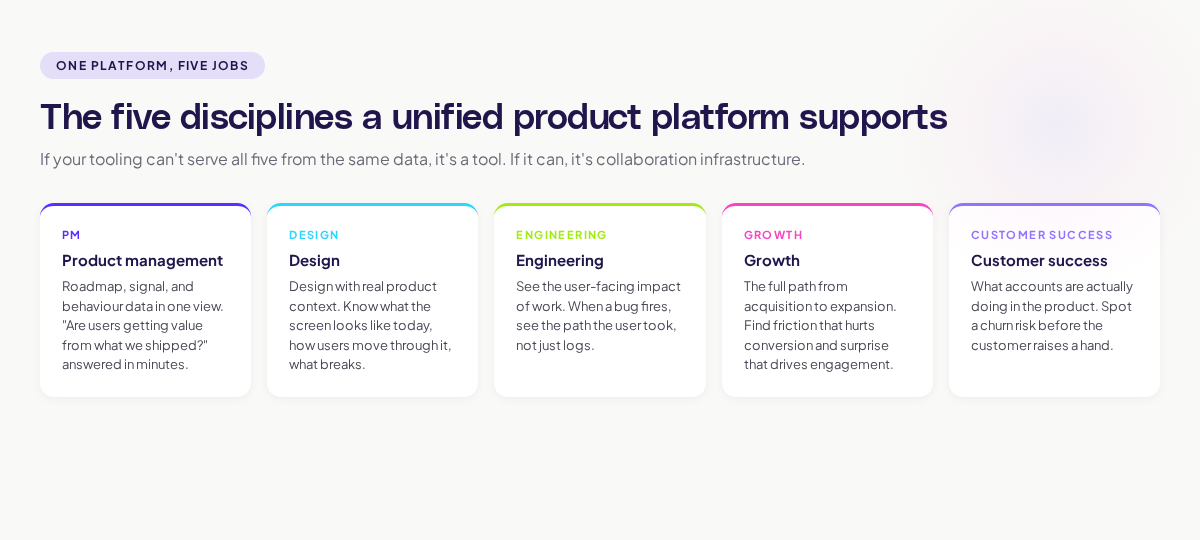
If you're evaluating whether your tooling supports real product team collaboration, here are the five disciplines a unified platform should serve, all from the same data.
1. Product management
PMs need the roadmap, the customer signal, and the product behaviour data in one view. They need to be able to ask "are users actually getting value from the feature we shipped last sprint?" and get a defensible answer in minutes, not days. They need to be able to share the answer with the rest of the team with a link, not a slide.
2. Design
Designers need to design with real product context, not blank canvases. They need to know what the screen they're redesigning looks like today, how users move into and out of it, and which user moments break first. They need a way to attach their proposed change to the journey, so the team can see the difference, not just the new artwork.
3. Engineering
Engineering needs to understand the user-facing impact of the work, not just the ticket. When a bug shows up, they need to see the path the user took before the error, not infer it from logs. When a feature is shipped, they need to see how it's being used, in real screens, not in dashboards three layers removed from the experience.
4. Growth
Growth teams need to see the full path a user takes from acquisition to activation to expansion. They need to find the moments of friction that hurt conversion and the moments of surprise that drive engagement. They need to feed those back to product without having to translate dashboards into stories.
5. Customer success
CSMs need to see what their accounts are actually doing in the product, not just what events fired. They need to spot a customer about to churn before that customer raises their hand. They need to surface the patterns from accounts they're worried about and show them to product, design, and engineering as evidence.
A platform that serves only one of these is a tool. A platform that serves all five from the same data is collaboration infrastructure.
The cost of fragmentation, in numbers
If you're trying to make the case for consolidating product tooling, the data is increasingly on your side.
Atlassian's research on context switching found that chronic tool-switching can consume up to 40% of a person's productive time. A team of ten people losing 40% to tool-switching is the equivalent of four full-time roles spent on nothing. That cost shows up nowhere on a P&L, but it shows up in every shipping cycle.
Microsoft's research on the same theme found that the average employee uses about ten different applications per day, switching between them roughly 25 times. The cost isn't just the time. It's the loss of focus. A small team that can stay inside one shared view for a working session will out-produce a much larger team that has to context-switch every twenty minutes.
The Microsoft Work Trend Index 2024 found that 54% of employees feel overworked and 39% feel exhausted. Tool fragmentation is one of the most addressable causes. Cutting the tool count by half doesn't just save money. It saves attention.
What to do if you can't change tools tomorrow
A lot of teams reading this can't simply consolidate their stack overnight. The rest of this section is for them.
Make one view the canonical view
Even if you can't unify the tools, you can unify the view. Pick the place where the team agrees the most truthful picture of the product lives. Make that the link everyone shares in standup, in design reviews, in customer success calls. The view becomes a centre of gravity even if the tools haven't merged.
Cut the syncs
If your standups are mostly people updating each other on what their tools say, kill the standup and replace it with a fifteen-minute end-of-day async. The decisions you actually need to make in real time will get a meeting of their own. The status updates don't need a meeting at all.
Co-locate decisions with evidence
When a decision gets made, write it down somewhere that links to the evidence that drove it. A roadmap entry that links to the journey map, the user feedback, and the data is far more durable than one that just lives in a spreadsheet.
Make handoffs visual, not textual
If a designer is handing a change to engineering, the handoff should be a screen change in context, not a paragraph of explanation. If a PM is handing a problem to design, the handoff should be a journey with the friction marked, not a Jira ticket with a sentence and a question mark.
These four moves don't require you to change your tools. They do require you to change your habits. The teams that do this consistently produce more, with less friction.
A short test for whether your collaboration is working
Three questions tell you honestly whether your product team is collaborating or just co-existing.
- When PM, design, and engineering disagree about a flow, can they resolve it by looking at the same data, in the same view, in less than five minutes?
- When a designer hands a change to engineering, does the handoff carry the journey context, or just the screen?
- When growth surfaces a friction point, does it show up in the next design review, or get re-discovered three months later?
A team that can answer yes to all three is collaborating. A team that can't is paying tax.
Where this is going
The next phase of product team collaboration is going to look less like Slack and more like Figma. The tools that win will be the ones that are visual-first, AI-augmented, and designed to be the place where the team thinks together, not just talks together.
The macro signal is that fragmentation is finally becoming visible. Companies are tracking tool count. Engineering leaders are pushing back on stack proliferation. Product leaders are asking why they need six tools to ship one feature. The answer, in most cases, is that they don't.
The teams that consolidate around a single visual source of truth, with PM, design, engineering, growth and customer success all working from the same view, will move faster than the teams that don't. By a lot. The cost of fragmentation has compounded for a decade. The savings from undoing it will too.
What to do this week
Three small moves, in order of impact.
- Count the tools. List every tool your product team touches in a normal week. Mark the ones that show the same data twice. Start there.
- Pick one cross-functional friction point in the last sprint where PM, design, and engineering ended up working from different versions of the truth. Walk through what would have changed if they'd started from the same view.
- Try one week with no standup, replaced by a single shared visual view of the product and an end-of-day async update. See whether the decisions still happen.
Product team collaboration is not a soft skill. It's a system you build, with tools, habits, and a shared view. The teams that build it well ship the kinds of products everyone else writes case studies about.
Related posts

Why We Built AI Product Insights
The story behind Adora's AI Insights, and why I think this is the future of how product teams operate.

Data-driven off a cliff: why dashboards are dead
Dashboards are dead. Not because data doesn't matter. But because the way we've been accessing it was never actually built for the people making product decisions. Here's what went wrong, and what comes next.

SaaS Pricing Pages to Sign Up Journeys
This teardown analyzes SaaS pricing pages and their connected sign up journeys. Learn how leading SaaS companies design pricing, CTAs, and sign up flows that reduce friction and increase conversion.